Should I inflate my loss ratios?14/12/2019 I remember being told as a relatively new actuarial analyst that you "shouldn't inflate loss ratios" when experience rating. This must have been sitting at the back of my mind ever since, because last week, when a colleague asked me basically the same question about adjusting loss ratios for claims inflation, I remembered the conversation I'd had with my old boss and it finally clicked. Let's go back a few years - it's 2016 - Justin Bieber has a song out in which he keeps apologising, and to all of us in the UK, Donald Trump (if you've even heard of him) is still just the America's version of Alan Sugar. I was working on the pricing for a Quota Share, I can't remember the class of business, but I'd been given an aggregate loss triangle, ultimate premium estimates, and rate change information. I had carefully and meticulously projected my losses to ultimate, applied rate changes, and then set the trended and developed losses against ultimate premiums. I ended up with a table that looked something like this: (Note these numbers are completely made up but should give you a gist of what I'm talking about.) 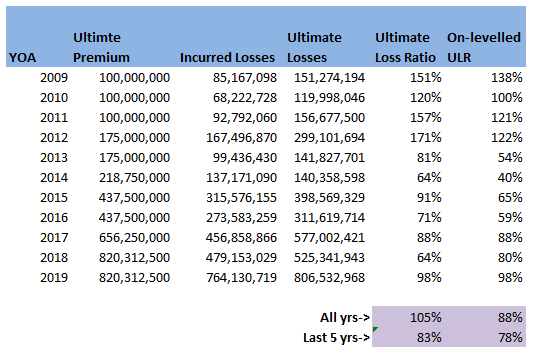
I then thought to myself ‘okay this is a property class, I should probably inflate losses by about $3\%$ pa’, the definition of a loss ratio is just losses divided by premium, therefore the correct way to adjust is to just inflate the ULR by $3\%$ pa. I did this, sent the analysis to my boss at the time to review, and was told ‘you shouldn’t inflate loss ratios for claims inflation, otherwise you'd need to inflate the premium as well’ – in my head I was like ‘hmmm, I don’t really get that...’ we’ve accounted for the change in premium by applying the rate change, claims certainly do increase each year, but I don't get how premiums also 'inflate' beyond rate movements?! but since he was the kind of actuary who is basically never wrong and we were short on time, I just took his word for it. I didn’t really think of it again, other than to remember that ‘you shouldn’t inflate loss ratios’, until last week one of my colleagues asked me if I knew what exactly this ‘Exposure trend’ adjustment in the experience rating modelling he’d been sent was. The actuaries who had prepared the work had taken the loss ratios, inflated them in line with claims inflation (what you're not supposed to do), but then applied an ‘exposure inflation’ to the premium. Ah-ha I thought to myself, this must be what my old boss meant by inflating premium. I'm not sure why it took me so long to get to the bottom of what, is when you get down to it, a fairly simple adjustment. In my defence, you really don’t see this approach in ‘London Market’ style actuarial modelling - it's not covered in the IFoA exams for example. Having investigated a little, it does seem to be an approach which is used by US actuaries more – possibly it’s in the CAS exams? When I googled the term 'Exposure Trend', not a huge amount of useful info came up – there are a few threads on Actuarial Outpost which kinda mention it, but after mulling it over for a while I think I understand what is going on. I thought I’d write up my understanding in case anyone else is curious and stumbles across this post. Proof by Example I thought it would be best to explain through an example, let’s suppose we are analysing a single risk over the course of one renewal. To keep things simple, we’ll assume it’s some form of property risk, which is covering Total Loss Only (TLO), i.e. we only pay out if the entire property is destroyed. Let’s suppose for $2018$, the TIV is $1m$ USD, we are getting a net premium rate of $1\%$ of TIV, and we think there is a $0.5\%$ chance of a total loss. For $2019$, the value of the property has increased by $5\%$, we are still getting a net rate of $1\%$, and we think the underlying probability of a total loss is the same. In this case we would say the rate change is $0\%$. That is: $$ \frac{\text{Net rate}_{19}}{\text{Net rate}_{18}} = \frac{1\%}{1\%} = 1 $$ However we would say that claim inflation is $5\%$, which is the increase in expected claims this follows from: $$ \text{Claim Inflation} = \frac{ \text{Expected Claims}_{19}}{ \text{Expected Claims}_{18}} = \frac{0.5\%*1.05m}{0.5\%*1m} = 1.05$$
From first principles, our expected gross gross ratio (GLR) for $2018$ is:
$$\frac{0.5 \% *(TIV_{18})}{1 \% *(TIV_{18})} = 50 \%$$ And for $2019$ is: $$\frac{0.5\%*(TIV_{19})}{1\%*(TIV_{19})} = 50\%$$ i.e. they are the same! The correct adjustment when on-levelling $2018$ to $2019$ should therefore result in a flat GLR – this follows as we’ve got the same GLR in each year when we calculated above from first principles. If we’d taken the $18$ GLR, applied the claims inflation $1.05$ and applied the rate change $1.0$, then we might erroneously think the Gross Loss Ratio would be $50\%*1.05 = 52.5\%$. This would be equivalent to what I did in the opening paragraph of this post, the issue being, that we haven’t accounted for trend in exposure and our rate change is a measure of the change in net rate. If we include this exposure trend as an additional explicit adjustment this gives $50\%*1.05*1/1.05 = 50\%$. Which is the correct answer, as we can see by comparing to our first principles calculation. So the fundamental problem, is that our measure of rate change is a measure in the movement of rate on TIV, whereas our claim inflation is a measure of the movement of aggregate claims. These two are misaligned, if our rate change was instead a measure in the movement of overall premium, then the two measures would be consistent and we would not need the additional adjustment. However it’s much more common in this type of situation to get given rate change as a measure of change in rate on TIV. An advantage of making an explicit adjustment for exposure trend and claims inflation is that it allows us to apply different rates – which is probably more accurate. There’s no a-priori justification as to why the two should always be the same. Claim inflation will be affected by additional factors beyond changes in the inflation of the assets being insured, this may include changes in frequency, changes in court award inflation, etc… It’s also interesting to note that the clam inflation here is of a different nature to what we would expect to see in a standard Collective Risk Model. In that case we inflate individual losses by the average change in severity i.e. ignoring any change in frequency. When adjusting the LR above, we are adjusting for both the change in frequency and severity together, i.e. in the aggregate loss. The above discussion also shows the importance of understanding exactly what someone means by ‘rate change’. It may sound obvious but there are actually a number of subtle differences in what exactly we are attempting to measure when using this concept. Is it change in premium per unit of exposure, is it change in rate per dollar of exposure, or is it even change in rate adequacy? At various points I’ve seen all of these referred to as ‘rate change’. Poisson Distribution for small Lambda23/4/2019
I was asked an interesting question a couple of weeks ago when talking through some modelling with a client.
We were modelling an airline account, and for various reasons we had decided to base our large loss modelling on a very basic top-down allocation method. We would take a view of the market losses at a few different return periods, and then using a scenario approach, would allocate losses to our client proportionately. Using this method, the frequency of losses is then scaled down by the % of major policies written, and the severity of losses is scaled down by the average line size. To give some concrete numbers (which I’ve made up as I probably shouldn’t go into exactly what the client’s numbers were), let's say the company was planning on taking a line on around 10% of the Major Airline Risks, and their average line was around 1%. We came up with a table of return periods for market level losses. The table looked something like following (the actual one was also different to the table below, but not miles off): 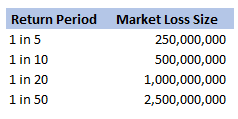
Then applying the 10% hit factor if there is a loss, and the 1% line written, we get the following table of return periods for our client:
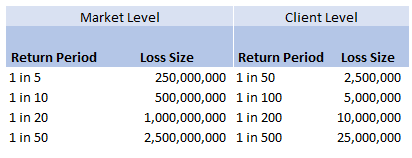
Hopefully all quite straightforward so far. As an aside, it is quite interesting to sometimes pare back all the assumptions to come up with something transparent and simple like the above. For airline risks, the largest single policy limit is around USD 2.5bn, so we are saying our worst case scenario is a single full limit loss, and that each year this has around a 1 in 50 chance of occurring. We can then directly translate that into an expected loss, in this case it equates to 50m (i.e. 2.5bn *0.02) of pure loss cost. If we don't think the market is paying this level of premium for this type of risk, then we better have a good reason for why we are writing the policy!
So all of this is interesting (I hope), but what was the original question the client asked me? We can see from the chart that for the market level the highest return period we have listed is 1 in 50. Clearly this does translate to a much longer return period at the client level, but in the meeting where I was asked the original question, we were just talking about the market level. The client was interested in what the 1 in 200 at the market level was and what was driving this in the modelling. The way I had structured the model was to use four separate risk sources, each with a Poisson frequency (lambda set to be equal to the relevant return period), and a fixed severity. So what this question translates to is, for small Lambdas $(<<1)$, what is the probability that $n=2$, $n=3$, etc.? And at what return period is the $n=2$ driving the $1$ in $200$? Let’s start with the definition of the Poisson distribution: Let $N \sim Poi(\lambda)$, then: $$P(N=n) = e^{-\lambda} \frac{ \lambda ^ n}{ n !} $$ We are interested in small $\lambda$ – note that for large $\lambda$ we can use a different approach and apply sterling’s approximation instead. Which if you are interested, I’ve written about here: www.lewiswalsh.net/blog/poisson-distribution-what-is-the-probability-the-distribution-is-equal-to-the-mean
For small lambda, the insight is to use a Taylor expansion of the $e^{-\lambda}$ term. The Taylor expansion of $e^{-\lambda}$ is:
$$ e^{-\lambda} = \sum_{i=0}^{\infty} \frac{\lambda^i}{ i!} = 1 - \lambda + \frac{\lambda^2}{2} + o(\lambda^2) $$
We can then examine the pdf of the Poisson distribution using this approximation: $$P(N=1) =\lambda e^{-\lambda} = \lambda ( 1 – \lambda + \frac{\lambda^2}{2} + o(\lambda^2) ) = \lambda - \lambda^2 +o(\lambda^2)$$
as in our example above, we have:
$$ P(N=1) ≈ \frac{1}{50} – {\frac{1}{50}}^2$$
This means that, for small lambda, the probability that $N$ is equal to $1$ is always slightly less than lambda. Now taking the case $N=2$: $$P(N=2) = \frac{\lambda^2}{2} e^{-\lambda} = \frac{\lambda^2}{2} (1 – \lambda +\frac{\lambda^2}{2} + o(\lambda^2)) = \frac{\lambda^2}{2} -\frac{\lambda^3}{2} +\frac{\lambda^4}{2} + o(\lambda^2) = \frac{\lambda^2}{2} + o(\lambda^2)$$
So once again, for $\lambda =\frac{ 1}{50}$ we have:
$$P(N=2) ≈ 1/50 ^ 2 /2 = P(N=1) * \lambda / 2$$
In this case, for our ‘1 in 50’ sized loss, we would expect to have two such losses in a year once every 5000 years! So this is definitely not driving our 1 in 200 result.
We can add some extra columns to our market level return periods as follows: 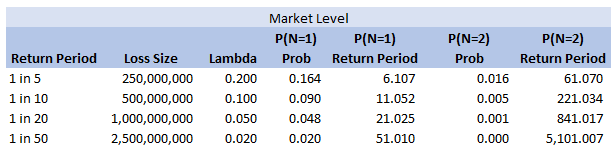
So we see for the assumptions we made, around the 1 in 200 level our losses are still primarily being driven by the P(N=1) of the 2.5bn loss, but then in addition we will have some losses coming through corresponding to P(N=2) and P(N=3) of the 250m and 500m level, and also combinations of the other return periods.
So is this the answer I gave to the client in the meeting? …. Kinda, I waffled on a bit about this kind of thing, but then it was only after getting back to the office that I thought about trying to breakdown analytically which loss levels we can expect to kick in at various return periods. Of course all of the above is nice but there is an easier way to see the answer, since we’d already stochastically generated a YLT based on these assumptions, we could have just looked at our YLT, sorted by loss size and then gone to the 99.5 percentile and see what sort of losses make up that level. The above analysis would have been more complicated if we have also varied the loss size stochastically. You would normally do this for all but the most basic analysis. The reason we didn’t in this case was so as to keep the model as simple and transparent as possible. If we had varied the loss size stochastically then the 1 in 200 would have been made up of frequency picks of various return periods, combined with severity picks of various return periods. We would have had to arbitrarily fix one in order to say anything interesting about the other one, which would not have been as interesting. Converting a Return Period to a RoL15/3/2019 I came across a useful way of looking at Rate on Lines last week, I was talking to a broker about what return periods to use in a model for various levels of airline market loss (USD250m, USD500m, etc.). The model was intended to be just a very high level, transparent market level model which we could use as a framework to discuss with an underwriter. We were talking through the reasonableness of the assumptions when the broker came out with the following: 'Well, you’d pay about 12.5 on line in the retro market at that attachment level, so that’s a 1 in 7 break-even right?' My response was: 'ummmm, come again?' His reasoning was as follows: Suppose the ILW pays $1$ @ $100$% reinstatements, and that it costs $12.5$% on line. Then if the layer suffers a loss, the insured will have a net position on the contract of $75$%. This is the $100$% limit which they receive due to the loss, minus the original $12.5$% Premium, minus an additional $12.5$% reinstatement Premium. The reinsurer will now need another $6$ years at $12.5$% RoL $(0.0125 * 6 = 0.75)$ to recover the limit and be at break-even. Here is a breakdown of the cashflow over the seven years for a $10m$ stretch at $12.5$% RoL: 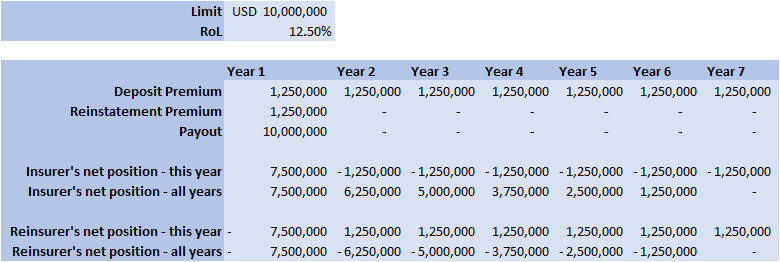 So the loss year plus the six clean years, tells us that if a loss occurs once every 7 years, then the contract is at break-even for this level of RoL.
So this is kind of cool - any time we have a RoL for a retro layer, we can immediately convert it to a Return Period for a loss which would trigger the layer. Generalisation 1 – various rates on line We can then generalise this reasoning to apply to a layer with an arbitrary RoL. Using the same reasoning as above, the break-even return period ends up being: $RP= 1 + \frac{(1-2*RoL)}{RoL}$ Inverting this gives: $RoL = \frac{1}{(1 + RP)}$ So let's say we have an ILW costing $7.5$% on line, the break-even return period is: $1 + \frac{(1-0.15)}{0.075} = 11.3$ Or let’s suppose we have a $1$ in $19$ return period, the RoL will be: $0.05 = \frac{1}{(1 + 19)}$ Generalisation 2 – other non-proportional layers The formula we derived above was originally intended to apply to ILWs, but it also holds any time we think the loss to the layer, if it occurs, will be a total loss. This might be the case for a cat layer, or a clash layers (layers which have an attachment above the underwriting limit for a single risk), or any layer with a relatively high attachment point compared to the underwriting limit. Adjustments to the formulas There are a few of adjustments we might need to make to these formulas before using them in practice. Firstly, the RoL above has no allowance for profit or expense loading, we can account for this by converting the market RoL to a technical RoL, this is done by simply dividing the RoL by $120-130$% (or any other appropriate profit/expense loading). This has the effect of increasing the number of years before the loss is expected to occur. Alternately, if layer does not have a paid reinstatement, or has a different factor than $100$%, then we would need to amend the multiple we are multiplying the RoL by in the formula above. For example, with nil paid reinstatements, the formula would be: $RP = 1 + \frac{(1-RoL)}{RoL}$ Another refinement we might wish to make would be to weaken the total loss assumption. We would then need to reduce the RoL by an appropriate amount to account for the possibility of partial losses. It’s going to be quite hard to say how much this should be adjusted for – the lower the layer the more it would need to be. It's the second week of your new job Capital Modelling job. After days spent sorting IT issues, getting lost coming back from the toilets, and perfecting your new commute to work (probability of getting a seat + probability of delay * average journey temperature.) your boss has finally given you your first real project to work on. You've been asked to carry out an annual update of the Underwriting Risk Capital Charge for a minor part of the company's Motor book. Not the grandest of analysis you'll admit, this particular class only makes up about 0.2% of the company's Gross Written Premium, and the Actuaries who reserve the company's bigger classes would probably consider the number of decimal places used in the annual report more material than your entire analysis. But you know in your heart of hearts that this is just another stepping stone on your inevitable meteoric rise to Chief Actuary in the Merger and Acquisition department, where one day you will pass judgement on billion dollar deals in-between expensive lunches with CFOs, and drinks with journalists on glamorous rooftop bars. The company uses in-house reserving software, but since you're not that familiar with it, and because you want to make a good impression, you decide to carry out extensive checking of the results in Excel. You fire up the Capital Modelling Software (which may or may not have a name that means a house made out of ice), put in your headphones and grind it out. Hours later you emerge triumphant, and you've really nailed it, your choice of correlation (0.4), and correlation method (Gaussian Copula) is perfect. As planned you run extracts of all the outputs, and go about checking them in Excel. But what's this? You set the correlation to be 0.4 in the software, but when you check the correlation yourself in Excel, it's only coming out at 0.384?! What's going on? Simulating using Copulas The above is basically what happened to me (minus most of the actual details. but I did set up some modelling with correlated random variables and then checked it myself in Excel and was surprised to find that the actual correlation in the generated output was always lower than the input.) I looked online but couldn't find anything explaining this phenomenon, so I did some investigating myself. So just to restate the problem, when using Monte Carlo simulation, and generating correlated random variables using the Copula method. When we actually check the correlation of the generated sample, it always has a lower correlation than the correlation we specified when setting up the modelling. My first thought for why this was happening was that were we not running enough simulations and that the correlations would eventually converge if we just jacked up the number of simulations. This is the kind of behaviour you see when using Monte Carlo simulation and not getting the mean or standard deviation expected from the sample. If you just churn through more simulations, your output will eventually converge. When creating Copulas using the Gaussian Method, this is not the case though, and we can test this. I generated the graph below in R to show the actual correlation we get when generating correlated random variables using the Copula method for a range of different numbers of simulations. There does seem to be some sort of loose limiting behaviour, as the number of simulations increases, but the limit appears to be around 0.384 rather than 0.4. 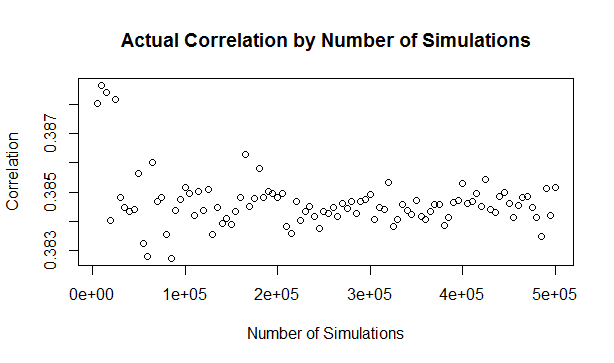
The actual explanation First, we need to briefly review the algorithm for generating random variables with a given correlation using the normal copula. Step 1 - Simulate from a multivariate normal distribution with the given covariance matrix. Step 2 - Apply an inverse gaussian transformation to generate random variables with marginal uniform distribution, but which still maintain a dependency structure Step 3 - Apply the marginal distributions we want to the random variables generated in step 2 We can work through these three steps ourselves, and check at each step what the correlation is. The first step is to generate a sample from the multivariate normal. I'll use a correlation of 0.4 though out this example. Here is the R code to generate the sample:
a <- library(MASS)
library(psych)
set.seed(100)
m <- 2
n <- 1000
sigma <- matrix(c(1, 0.4,
0.4, 1),
nrow=2)
z <- mvrnorm(n,mu=rep(0, m),Sigma=sigma,empirical=T)
And here is a Scatterplot of the generated sample from the multivariate normal distribution: 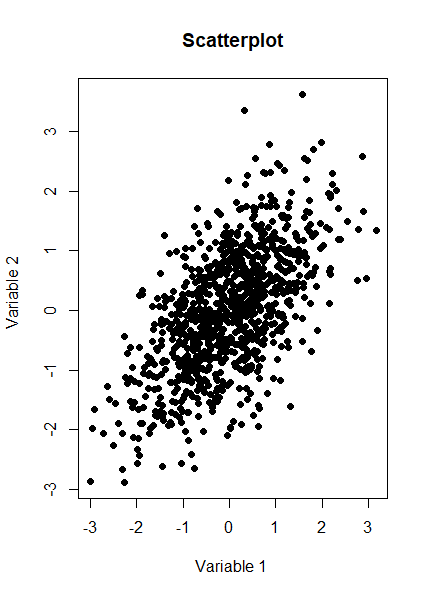
We now want to check the product moment correlation of our sample, which we can do using the following code: cor(z,method='pearson') Which gives us the following result: > cor(z,method='pearson') [,1] [,2] [1,] 1.0 0.4 [2,] 0.4 1.0 So we see that the correlation is 0.4 as expected. The Psych package has a useful function which produces a summary showing a Scatterplot, the two marginal distribution, and the correlation: 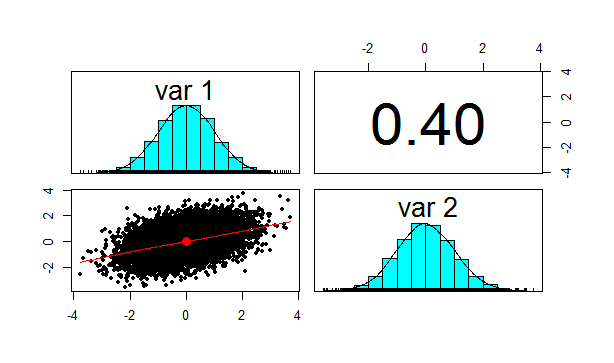
Let us also check Kendall's Tau and Spearman's rank at this point. This will be instructive later on. We can do this using the following code: cor(z,method='spearman') cor(z,method='Kendall') Which gives us the following results: > cor(z,method='spearman') [,1] [,2] [1,] 1.0000000 0.3787886 [2,] 0.3787886 1.0000000 > cor(z,method='kendall') [,1] [,2] [1,] 1.0000000 0.2588952 [2,] 0.2588952 1.0000000 Note that this is less than 0.4 as well, but we will discuss this further later on.
We now need to apply step 2 of the algorithm, which is applying the inverse Gaussian transformation to our multivariate normal distribution. We can do this using the following code:
u <- pnorm(z) We now want to check the correlation again, which we can do using the following code: cor(z,method='spearman') Which gives the following result: > cor(z,method='spearman') [,1] [,2] [1,] 1.0000000 0.3787886 [2,] 0.3787886 1.0000000 Here is the Psych summary again: 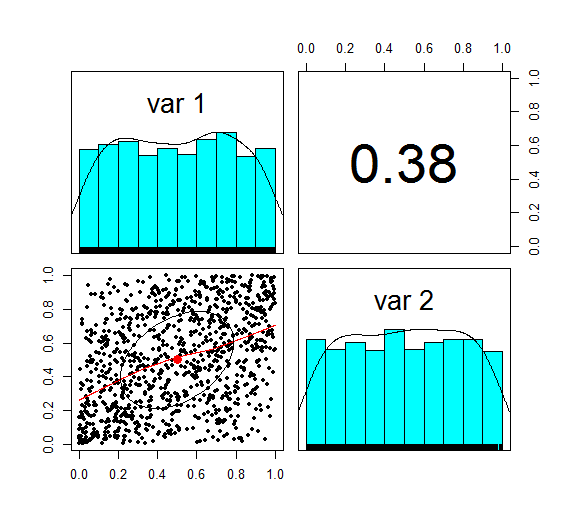
u is now marginally uniform (hence the name). We can see this by looking at the Scatterplot and marginal pdfs above. We also see that the correlation has dropped to 0.379, down from 0.4 at step 1. The Pearson correlation measures the linear correlation between two random variables. We generated normal random variables, which had the required correlation, but then we applied a non-linear (inverse Gaussian) transformation. This non-linear step is the source of the dropped correlation in our algorithm. We can also retest Kendall's Tau, and Spearman's at this point using the following code: cor(z,method='spearman') cor(z,method='Kendall') This gives us the following result: > cor(u,method='spearman') [,1] [,2] [1,] 1.0000000 0.3781471 [2,] 0.3781471 1.0000000 > cor(u,method='kendall') [,1] [,2] [1,] 1.0000000 0.2587187 [2,] 0.2587187 1.0000000 Interestingly, these values have not changed from above! i.e. we have preserved these measures of correlation between step 1 and step 2. It's only the Pearson correlation measure (which is a measure of linear correlation) which has not been preserved. Let's now apply the step 3, and once again retest our three correlations. The code to carry out step 3 is below: x1 <- qgamma(u[,1],shape=2,scale=1) x2 <- qbeta(u[,2],2,2) df <- cbind(x1,x2) pairs.panels(df) The summary for step 3 looks like the following. 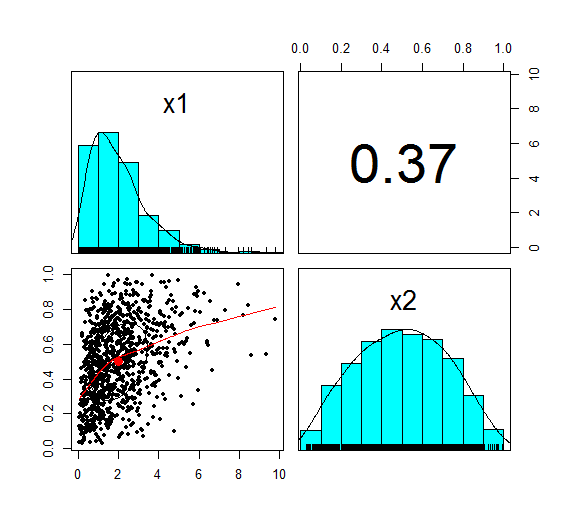
This is the end goal of our method. We see that our two marginal distributions have the required distribution, and we have a correlation between them of 0.37. Let's recheck our three measures of correlation. cor(df,method='pearson') cor(df,meth='spearman') cor(df,method='kendall') > cor(df,method='pearson') x1 x2 x1 1.0000000 0.3666192 x2 0.3666192 1.0000000 > cor(df,meth='spearman') x1 x2 x1 1.0000000 0.3781471 x2 0.3781471 1.0000000 > cor(df,method='kendall') x1 x2 x1 1.0000000 0.2587187 x2 0.2587187 1.0000000 So the Pearson has reduced again at this step, but the Spearman and Kendall's Tau are once again the same.
Does this matter?
This does matter, let's suppose you are carrying out capital modelling and using this method to correlate your risk sources. Then you would be underestimating the correlation between random variables, and therefore potentially underestimating the risk you are modelling. Is this just because we are using a Gaussian Copula? No, this is the case for all Copulas. Is there anything you can do about it? Yes, one solution is to just increase the input correlation by a small amount, until we get the output we want. A more elegant solution would be to build this scaling into the method. The amount of correlation lost at the second step is dependent just on the input value selected, so we could pre-compute a table of input and output correlations, and then based on the desired output, we would be able to look up the exact input value to use. It is quite simple to calculate the Reinstatement Premium resulting from a loss to an Excess of Loss contract. Therefore, it seems reasonable that we should be able to come up with a simple formula relating the price charged for the Excess of Loss contract to the price charged for the Reinstatement Premium Protection (RPP) cover. I was in a meeting last week with two brokers who were trying to do just this. We had come up with an indicative price for an XoL layer and we were trying to use this to price the equivalent RPP cover. At the time I didn't have an easy way to do it, and when I did a quick Google search nothing came up. Upon further reflection, there are a couple of easy approximate methods we can use. Below I discuss three different methods which can be used to price an RPP cover, two of which do not require any stochastic modelling. Let's quickly review a few definitions, feel free to skip this section if you just want the formula. What is a Reinstatement Premium? A majority of Excess of Loss contracts will have some form of reinstatement premium. This is a payment from the Insurer to the Reinsurer to reinstate the protection in the event some of the limit is eroded. In the London market, most contracts will have either $1$, $2$, or $3$ reinstatements and generally these will be payable at $100 \%$. From the point of view of the insurer, this additional payment comes at the worst possible time, the Reinsured is being asked to fork over another large premium to the Reinsurer just after having suffered a loss. What is a Reinstatement Premium Protection (RPP)? Reinsurers developed a product called a Reinstatement Premium Protection cover (RPP cover). This cover pays the Reinsured's Reinstatement Premium for them, giveing the insurer further indemnification in the event of a loss. Here's an example of how it works in practice: Let's suppose we are considering a $5m$ xs $5m$ Excess of Loss contract, there is one reinstatement at $100 \%$ (written $1$ @ $100 \%$), and the Rate on Line is $25 \%$. The Rate on Line is just the Premium divided by the Limit. So the Premium can be found by multiplying the Limit and the RoL: $$5m* 25 \% = 1.25m$$ So we see that the Insurer will have to pay the Reinsurer $1.25m$ at the start of the contract. Now let's suppose there is a loss of $7m$. The Insurer will recover $2m$ from the Resinsurer, but they will also have to make a payment to cover the reinstatement premium of: $\frac {2m} {5m} * (5m * 25 \% ) = 2m * 25 \% = 0.5m$ to reinstate the cover. So the Insurer will actually have to pay out $5.5m$. The RPP cover, if purchased by the insurer, would pay the additional $0.5m$ on behalf of the insurer, in exchange for a further upfront premium. Now that we know how it works, how would we price the RPP cover? Three methods for pricing an RPP cover Method 1 - Full stochastic model If we have priced the original Excess of Loss layer ourselves using a Monte Carlo model, then it should be relatively straight forward to price the RPP cover. We can just look at the expected Reinstatements, and apply a suitable loading for profit and expenses. This loading will probably be broadly in line with the loading that is applied to the expected losses to the Excess of Loss layer, but accounting for the fact that the writer of the RPP cover will not receive any form of Reinstatement for their Reinsurance. What if we do not have a stochastic model set up to price the Excess of Loss layer? What if all we know is the price being charged for the Excess of Loss layer? Method 2 - Simple formula Here is a simple formula we can use which gives the price to charge for an RPP, based on just the deposit premium and the Rate on Line, full derivation below: $$RPP = DP * ROL $$ When attempting to price the RPP last week, I did not have a stochastic model set up. We had come up with the pricing just based off the burning cost and a couple of 'commercial adjustments'. The brokers wanted to use this to come up with the price for the RPP cover. The two should be related, as they pay out dependant on the same underlying losses. So what can we say? If we denote the Expected Losses to the layer by $EL$, then the Expected Reinstatement Premium should be: $$EL * ROL $$ To see this is the case, I used the following reasoning; if we had losses in one year equal to the $EL$ (I'm talking about actual losses, not expected losses here), then the Reinstatement Premium for that year would be the proportion of the layer which had been exhausted $\frac {EL} {Limit} $ multiplied by the Deposit Premium $Limit * ROL$ i.e.: $$ RPP = \frac{EL} {Limit} * Limit * ROL = EL * ROL$$ Great! So we have our formula right? The issue now is that we don't know what the $EL$ is. We do however know the $ROL$, does this help? If we let $DP$ denote the deposit premium, which is the amount we initially pay for the Excess of Loss layer and we assume that we are dealing with a working layer, then we can assume that: $$DP = EL * (1 + \text{ Profit and Expense Loading } ) $$ Plugging this into our formula above, we can then conclude that the expected Reinstatement Premiums will be: $$\frac {DP} { \text{ Profit and Expense Loading } } * ROL $$ In order to turn this into a price (which we will denote $RPP$) rather than an expected loss, we then need to load our formula for profit and expenses i.e. $$RPP = \frac {DP} {\text{ Profit and Expense Loading }} * ROL * ( \text{ Profit and Expense Loading } ) $$Which with cancellation gives us: $$RPP = DP * ROL $$ Which is our first very simple formula for the price that should be charged for an RPP. Was there anything we missed out though in our analysis? Method 3 - A more complicated formula: There is one subtlety we glossed over in order to get our simple formula. The writer of the Excess of Loss layer will also receive the Reinstatement Premiums during the course of the contract. The writer of the RPP cover on the other hand, will not receive any reinstatement premiums (or anything equivalent to a reinstatement premium). Therefore, when comparing the Premium charged for an Excess of Loss layer against the Premium charged for the equivalent RPP layer, we should actually consider the total expected Premium for the Excess of Loss Layer rather than just the Deposit Premium. What will the additional premium be? We already have a formula for the expected Reinstatement premium: $$EL * ROL $$ Therefore the total expected premium for the Excess of Loss Layer is the Deposit Premium plus the additional Premium: $$ DP + EL * ROL $$ This total expected premium is charged in exchange for an expected loss of $EL$. So at this point we know the Total Expected Premium for the Excess of Loss contract, and we can relate the expected loss to the Excess of Loss layer to the Expected Loss to the RPP contract. i.e. For an expected loss to the RPP of $EL * ROL$, we would actually expect an equivalent premium for the RPP to be: $$ RPP = (DP + EL * ROL) * ROL $$ This formula is already loaded for Profit and Expenses, as it is based on the total premium charged for the Excess of Loss contract. It does however still contain the $EL$ as one of its terms which we do not know. We have two choices at this point. We can either come up with an assumption for the profit and expense loading (which in this hard market might be as little as only be $5 \% - 10 \%$ ). And then replace $EL$ with a scaled down $DP$: $$RPP = \frac{DP} {1.075} * ( 1 + ROL) * ROL $$ Or we could simply replace the $EL$ with the $DP$, which is partially justified by the fact that the $EL$ is only used to multiply the $ROL$, and will therefore have a relatively small impact on the result. Giving us the following formula: $$RPP = DP ( 1 + ROL) * ROL $$ Which of the three methods is the best? The full stochastic model is always going to be the most accurate in my opinion. If we do not have access to one though, then out of the two formulas, the more complicated formula we derived should be more accurate (by which I mean more actuarially correct). If I was doing this in practice, I would probably calculate both, to generate some sort of range, but tend towards the second formula. That being said, when I compared the prices that the Brokers had come up with, which is based on what they thought they could actually place in the market, against my formulas, I found that the simple version of the formula was actually closer to the Broker's estimate of how much these contacts could be placed for in the market. Since the simple formula always comes out with a lower price than the more complicated formula, this suggests that there is a tendency for RPPs to be under-priced in the market. This systematic under-pricing may be driven by commercial considerations rather than faulty reasoning on the part of market participants. According to the Broker I was discussing these contracts with, a common reason for placing an RPP is to give a Reinsurer who does not currently have a line on the underlying Excess of Loss layer, but who would like to start writing it, a chance to have an involvement in the same risk, without diminishing the signed lines for the existing markets. So let's say that Reinsurer A writes $100 \%$ of the Excess of Loss contract, and Reinsurer B would like to take a line on the contract. The only way to give them a line on the Excess of Loss contract is to reduce the line that Reinsurer A has. The insurer may not wish to do this though if Reinsurer A is keen to maintain their line. So the Insurer may allow Reinsurer B to write the RPP cover instead, and leave Reinsurer A with $100 \%$ of the Excess of Loss contract. This commercial factor may be one of the reasons that traditionally writers of an RPP would be inclined to give favourable terms relative to the Excess of Loss layer so as to encourage the insurer to allow them on to the main programme and to encourage them to allow them to wrte the RPP cover at all. Moral Hazard One point that is quite interesting to note about how these deals are structured is that RPP covers can have quite a significant moral hazard effect on the Insurer. The existence of Reinstatement Premiums is at least partially a mechanism to prevent moral hazard on the part of the Insurer. To see why this is the case, let's go back to our example of the $5m$ xs $5m$ layer. An insurer who purchases this layer is now exposed to the first $5m$ of any loss. But they are indemnified for the portion of the loss above $5m$, up to a limit of $5m$. If the insurer is presented with two risks which are seeking insurance - one with a total sum insured of $10m$, and another with a total sum insured of $6m$, the net retained exposure is the same for both risks from the point of view of the insurer. By including a reinstatement premium as part of the Excess of Loss layer, an therefore ensuring that the insurer has to make a payment any time a loss ceded to the layer, the reinsurer is ensuring that the insurer keeps their financial incentive to not have losses in this range. By purchasing an RPP cover, the insurer is removing their financial interest in losses which are ceded to the layer. There is an interesting conflict of interest in that the RPP cover will almost always be written by a different reinsurer to the Excess of Loss layer. The Reinsurer that is writing the RPP cover is therefore increasing the moral hazard risk whichever Reinsurer has written the Excess of Loss layer. Which will almost always be business written by one of the Reinsurer's competitors! Working Layers and unlimited Reinstatements Another point to note is that this pricing analysis makes a couple of implicit assumptions. The first is that there is a sensible relationship between the expected loss to the layer and the premium charged for the layer. This will normally only be the case for 'working layers'. These are layers to which a reasonable amount of loss activity is expected. If we are dealing with clash or other higher layers, then the pricing of these layers will be more heavily driven by considerations beyond the expected loss to the layer. These might be capital considerations on the part of the Reinsurer, commercial considerations such as Another implicit assumption in this analysis is that the reinstatements offered are unlimited,. If this is not the case, then the statement that the expected reinstatement is $EL * ROL$ no longer holds. If we have limited reinstatements (which is the case in practice most of the time) then we would expect the expected reinstatement to be less than or equal to this.
I offer tutoring for IFoA exams and actuarial modules. Details here www.lewiswalsh.net/tutoring.html
Compound Poisson Loss Model in VBA13/12/2017 I was attempting to set up a Loss Model in VBA at work yesterday. The model was a Compound-Poisson Frequency-Severity model, where the number of events is simulated from a Poisson distribution, and the Severity of events is simulated from a Severity curve. There are a couple of issues you naturally come across when writing this kind of model in VBA. Firstly, the inbuilt array methods are pretty useless, in particular dynamically resizing an array is not easy, and therefore when initialising each array it's easier to come up with an upper bound on the size of the array at the beginning of the program and then not have to amend the array size later on. Secondly, Excel has quite a low memory limit compared to the total available memory. This is made worse by the fact that we are still using 32-bit Office on most of our computers (for compatibility reasons) which has even lower limits. This memory limit is the reason we've all seen the annoying 'Out of Memory' error, forcing you to close Excel completely and reopen it in order to run a macro. The output of the VBA model was going to be a YLT (Yearly Loss Table), which could then easily be pasted into another model. Here is an example of a YLT with some made up numbers to give you an idea: 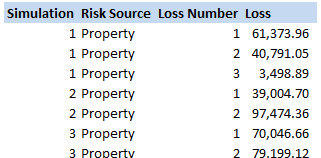
It is much quicker in VBA to create the entire YLT in VBA and then paste it to Excel at the end, rather than pasting one row at a time to Excel. Especially since we would normally run between 10,000 and 50,000 simulations when carrying out a Monte Carlo Simulation. We therefore need to create and store an array when running the program with enough rows for the total number of losses across all simulations, but we won't know how many losses we will have until we actually simulate them. And this is where we come across our main problem. We need to come up with an upper bound for the size of this array due to the issues with dynamically resizing arrays, but since this is going to be a massive array, we want the upper bound to be as small as possible so as to reduce the chance of a memory overflow error. Upper Bound What we need then is an upper bound on the total number of losses across all the simulations years. Let us denote our Frequency Distribution by $N_i$, and the number of Simulations by $n$. We know that $N_i$ ~ $ Poi( \lambda ) \: \forall i$. Lets denote the total size of the YLT array by $T$. We know that $T$ is going to be: $$T = \sum_{1}^{n} N_i$$ We now use the result that the sum of two independent Poisson distributions is also a Poisson distribution with parameter equal to the sum of the two parameters. That is, if $X$ ~ $Poi( \lambda)$ , and $Y$ ~ $Poi( \mu)$, then $X + Y$ ~ $Poi( \lambda + \mu)$. By induction this result can then be extended to any finite sum of independent Poisson Distributions. Allowing us to rewrite $T$ as: $$ T \sim Poi( n \lambda ) $$ We now use another result, a Poisson Distribution approaches a Normally Distribution as $ \lambda \to \infty $. In this case, $ n \lambda $ is certainly large, as $n$ is going to be set to be at least $10,000$. We can therefore say that: $$ T \sim N ( n \lambda , n \lambda ) $$ Remember that $T$ is the distribution of the total number of losses in the YLT, and that we are interested in coming up with an upper bound for $T$. Let's say we are willing to accept a probabilistic upper bound. If our upper bound works 1 in 1,000,000 times, then we are happy to base our program on it. If this were the case, even if we had a team of 20 people, running the program 10 times a day each, the probability of the program failing even once in an entire year is only 4%. I then calculated the $Z$ values for a range of probabilities, where $Z$ is the unit Normal Distribution, in particular, I included the 1 in 1,000,000 Z value. 
We then need to convert our requirement on $T$ to an equivalent requirement on $Z$. $$ P ( T \leq x ) = p $$ If we now adjust $T$ so that it can be replaced with a standard Normal Distribution, we get: $$P \left( \frac {T - n \lambda} { \sqrt{ n \lambda } } \leq \frac {x - n \lambda} { \sqrt{ n \lambda } } \right) = p $$
Now replacing the left hand side with $Z$ gives:
$$P \left( Z \leq \frac {x - n \lambda} { \sqrt{ n \lambda } } \right) = p $$
Hence, our upper bound is given by:
$$T \lessapprox Z \sqrt{n \lambda} + n \lambda $$
Dividing through by $n \lambda $ converts this to an upper bound on the factor above the mean of the distribution. Giving us the following:
$$ T \lessapprox Z \frac {1} { \sqrt{n \lambda}} + 1 $$
We can see that given $n \lambda$ is expected to be very large and the $Z$ values relatively modest, this bound is actually very tight.
For example, if we assume that $n = 50,000$, and $\lambda = 3$, then we have the following bounds: 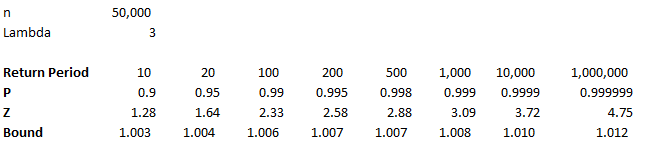
So we see that even at the 1 in 1,000,000 level, we only need to set the YLT array size to be 1.2% above the mean in order to not have any overflow errors on our array. References (1) Proof that the sum of two independent Poisson Distributions is another Poisson Distribution math.stackexchange.com/questions/221078/poisson-distribution-of-sum-of-two-random-independent-variables-x-y
(2) Normal Approximation to the Poisson Distribution.
stats.stackexchange.com/questions/83283/normal-approximation-to-the-poisson-distribution Combining two Rate Change Indices12/12/2017 I came across this problem at work last week, and I don't think there's anything in the notes on how to deal with it, so I have written up an explanation of how I solved it. Suppose we are carrying out a rating exercise on a number of lines of business. For two of the lines of business, Marine Hull and Marine Cargo, we have very few claims so we have decided to group these two lines together for the purpose of the Experience Rating exercise. We have been supplied with separate rate change indices for all the lines of business. How do we combine the Hull and Cargo Rate Change indices? Firstly, let's review a few basics: What is a rate change? It is a measure of the change in price of insurance from one year to the next when all else is constant. Why do we need a rate change? We will often use historic premium as an exposure measure when experience rating a book of business. If we do not adjust for the change in price of insurance then we may under or over estimate the rate of historic losses. What do we mean when we say the rate change 'for 2018'? This answer is debatable, and if there is any uncertainty it is always better to check with whoever compiled the data, but generally the '2018' rate change means the 2017 - 2018 rate change. How do we combine the rate changes from two lines of business? Let's work though an example to show how to do this. I am going to be using some data I made up. These figures were generated using the random number generator in excel, please don't use them for any actual work! Suppose we are given the following Premium estimates: 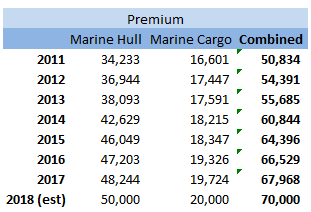 And that we are also given the following rate changes: 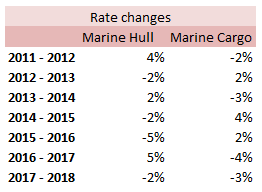 Then first we need to adjust the rate changes so that they are in an index. We do this by setting 2018 to be equal to 100%, and then recursively calculating the previous years using: $${Index}_n = {Index}_{n-1} (1 - {(Rate \: Change )}_{n-1} ) $$ 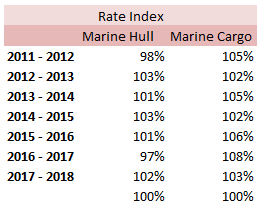 We can then calculate our On-Levelled Premiums, by simply multiplying our Premium figures by the Rate Change Index. $${ ( On \: Levelled \: Premium ) }_n = ({Premium}_n) \: ({Index}_n) $$ 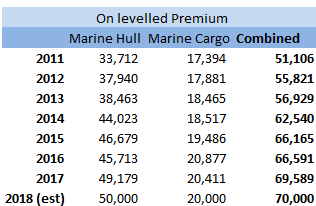 Using the combined on-levelled premiums, we can then calculate our combined Rate Index using the following formula: $${Index}_n = \frac{ { ( On \: Levelled \: Premium ) }_n } { {Premium}_n } $$ And our combined Rate Change using the following formula: $${Rate Change}_{n-1} = \frac{ {Index}_n } { {Index}_{n-1}} -1 $$ 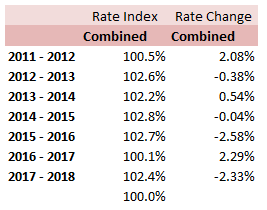 Most of the time we will only be interested in the combined On-Levelled Premium. The combined Rate Change is only a means to an end to obtain the combined On-Levelled Premium. If we have a model though where we need to input a combined Rate Change in order to group the two classes of business, then the method above can be used to obtain the required Rate Changes. Types of Excess of Loss Reinsurance24/10/2017 One thing that I got slightly confused about when I started to work at my current job was the difference between the various types of Excess of Loss Reinsurance. The descriptions given in the IFoA notes, those given on Wikipedia, and the use of the terms in the London market are all different.  The underlying contracts are all the same, but different groups have different names for them. I thought I would make a post explaining the differences. Here are the names of the sub-types of Excess of Loss Reinsurance that are used in the London Market:
(The descriptions given below just describe the basic functionality of the contracts. There will be a lot more detail in the contracts. It's always a good idea to read the slip if possible to properly understand the contract. Also, bear in mind that some people in the London Market might use these terms differently. This just represents what I would understand if someone said one of these terms to me in everyday work.) Risk Excess (RXS) The limit and attachment for this contract applies individually per risk rather than in aggregate per loss. (hence why it is called a Risk Excess) So if our RXS is 5m xs 1m and we have a loss involving two risks each of which is individually a 3m loss. The total recovery will be 4m = (3m-1m) + (3m - 1m) Excess of Loss (XoL) The limit and attachment for this contract apply in aggregate per loss rather than individually per risk. So if our XoL is 5m xs 1m and we have a loss involving two risks each of which is individually a 3m loss. The total recovery will be 5m = (6m-1m) Catastrophe XL (Cat XL) The limit and attachment for this contract apply in aggregate for losses to all policies covered by the contract during the duration of a Catastrophe. So if our Cat XL is 500m xs 100m, and there is a Hurricane which causes insured losses of 300m, then the total recovery will be 200m = (300m - 100m) Aggregate XL (Agg XL) The limit and attachment for this contract apply in aggregate for losses to all policies covered by the contract. This will normally be all policies in a single class. So if our Agg XL is 50m xs 10m and covers an Insurer's Aviation account. If the total Aviation losses for the year are 30m. Then the total recovery will be 20m = (30m - 10m)  The IFoA notes The IFoA notes distinguish between three types of Excess of Loss contract.
The definitions for Risk Excess of Loss and Catastrophe Excess of Loss are basically the same as those commonly used in the London Market. The IFoA definition of Aggregate Excess of Loss is different though. The Institute defines an Aggregate Excess of Loss Contract to be an Excess of Loss contract which aggregates losses across multiple risks in some way. This could be across all risks involved in one event, across all policies for a given year, across all losses in a given sub-class, etc. So our standard Excess of Loss contract which we defined above, which aggregates across all risks involved in a single loss, would be considered an example of an aggregate contract according to the IFoA definition! Don't go around Lloyd's calling it an Aggregate Excess of Loss though, people will get very confused. The IFoA definitions are more logical than the ones used in the London Market, where there is an arbitrary distinction between two types of aggregation. Our standard XoL contract does aggregate losses, therefore why not call it an Agg XoL? The reason we do call it that is because everyone else does, which when talking about definitions is a pretty compelling reason, even if it is not the most logical name. Wikipedia The Wikipedia page for Reinsurance (link below) distinguishes between three types of Excess of Loss contract. en.wikipedia.org/wiki/Reinsurance
Per Risk Excess of Loss is once again defined consistently, and the Aggregate Excess of Loss is also consistent with the common usage in the London Market. However, in this case, our standard Excess of Loss contract now falls under the definition of a Catastrophe Excess of Loss Layer. The Wiki article defines a Cat Excess of Loss contract to be one that aggregates across an Occurrence or Event - where event can either be a catastrophe, such as a Hurricane, or a single loss involving multiple risks. Summary You shouldn't get caught up in who is right or wrong, as long as you are clear which definitions you are using. Fundamentally we are talking about the same underlying contracts, it's all just semantics. The definitions that are commonly used in the London Market are not online anywhere that I could see, and it caused me some confusion when I noticed the inconsistency did some googling, and nothing came up. Hopefully this helps clarify the situation to anyone else who gets confused in the future. I offer tutoring for IFoA exams and actuarial modules. Details here www.lewiswalsh.net/tutoring.html
What even are Ogden Rates anyway? The Ogden tables are tables of annuity factors, published by the Government's Actuary Department, which are used to calculate court awards for claimants who have had life changing injuries or a fatal accident and are eligible for a payout from their insurance policy. For example, consider a 50 year old, male, primary school teacher who suffers a car accident which means that they will not be able to work for the rest of their life. The Ogden Tables will be used to calculate how much they should be paid now to compensate them for their loss of earnings. Suppose the teacher is earning a salary of £33,000 when they have the accident, then under the Ogden Rates prior to March 2017, the teacher would be paid a lump sum of £33,000* 20.53 = £677,490 where 20.53 is the factor from the tables. How did the Government's Actuary Department come up with these factors? The factors in the table are based on two main pieces of information, how long the person is expected to live, and how much money they can earn from the lump sum once they are given it (called the discount rate). It's this second part which has caused all the problems between the Ministry of Justice and the Insurance Industry. The discount rate should be selected to match the return generated on assets. For example, if the claimant puts all their money in shares then on average, they will generate much more income than if they put the lump sum in a savings account. So what should we assume our school teacher will invest their lump sum in? Since the school teacher will not be able to work again, and therefore will need to live off this money for the rest of their life, they will not want to risk losing all their money by investing in something too risky. In technical terms, we would say that the claimant is a risk adverse investor. In order to mimic the investment style of this risk adverse investor, when the Ogden tables were first set, it was decided to assume that the investor would put all their money in index-linked bonds. There are a couple of reasons to assume this, many risk adverse institutional investors do purchase a lot of index-linked bonds, and also, the average discount rate for these bonds is readily available as it is already published by the UK DMO. At the time the tables were set up, this seemed like a great idea, but recently it has made a lot of people very angry and been widely regarded as a bad move. What are Index-linked bonds again? In the 1981 the UK government started issuing a series of gilts which instead of paying a fixed coupon, paid a floating coupon which was a fixed percentage above the rate of inflation. The UK Debt Management Office is responsible for issuing these bonds, and the following website has details of the bonds that are currently in issue. It's quite interesting to see how it all works: www.dmo.gov.uk/reportView.aspx?rptCode=D1D&rptName=50545854&reportpage=D1D The basic principle is if you purchase a bond that pays 2% coupons, if inflation is 3%, they would pay 3%+2%, if inflation was 5%, then they would pay 5% + 2%. Due to the fact that these bonds always gave a fixed real return (2% in this case), institutional investors really like them. Because there is no inflation risk, on average index-linked bonds cost more than fixed coupon bonds once you account for the effects of inflation. Pension Schemes in particular purchase a lot of these bonds, Why do Pension Schemes like these bonds so much? Most pensions are increased annually in line with inflation, due to this Pension Schemes like to hold assets that also go up in line with inflation every year. In order to get real returns on their investments, Pension Schemes traditionally held a mix of shares and index-linked bonds, the shares gave better returns, but the bonds were more safe. This all started to go very wrong after the financial crisis . A huge drop in interest rates and investment returns, combined with soaring life expectancy lead to more and more pension schemes winding up and the remaining ones have funding issues. As the schemes started winding up they became more and more risk adverse and started to move away from the more volatile assets like shares and moved towards index-linked bonds instead. This table from the PPF's Purple Book shows the move away from shares into bonds. 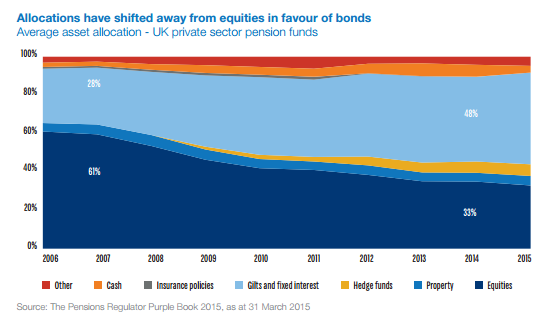 We can see that back in 2006, prior to the financial crisis, Pension Schemes were on average holding around 61% of their assets in equities. When we look again at 2014 this percentage has dropped to 33% and the slack has largely been taken up by bonds. Pension Schemes like these assets so much in fact that Schroders estimated that 80% of the long term index-linked gilts market is held by private sector pension schemes as the following chart shows. Source: www.schroders.co.uk/en/SysGlobalAssets/schroders/sites/ukpensions/pdfs/2016-06-pension-schemes-and-index-linked-gilts.pdf 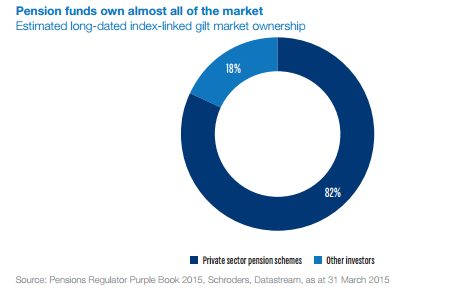 Does it matter that Pension Schemes own such a high proportion of these gilts? The problem with the index-linked gilt market being dominated by Pension Schemes is one of supply and demand. The demand for these bonds from Pension Schemes far outweighs the supply of the bonds. Another chart from Schroder's estimates the demand for the bonds is almost 5 times the supply. Source: www.schroders.co.uk/en/SysGlobalAssets/schroders/sites/ukpensions/pdfs/2016-06-pension-schemes-and-index-linked-gilts.pdf 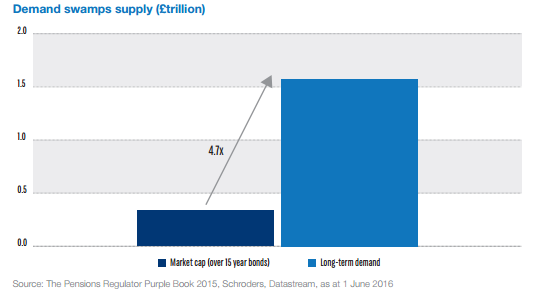 As you might expect with such a disparity between supply and demand, Pension funds have been chasing these assets so much that yields have actually become negative. This means that Pension Schemes on average are paying the government to hold their money for them, as long as it's protected against inflation. Here is a chart showing the yield over the last 5 years for a 1.25% 2032 index-linked gilt. Source: www.fixedincomeinvestor.co.uk/x/bondchart.html?id=3473&stash=F67129F0&groupid=3530 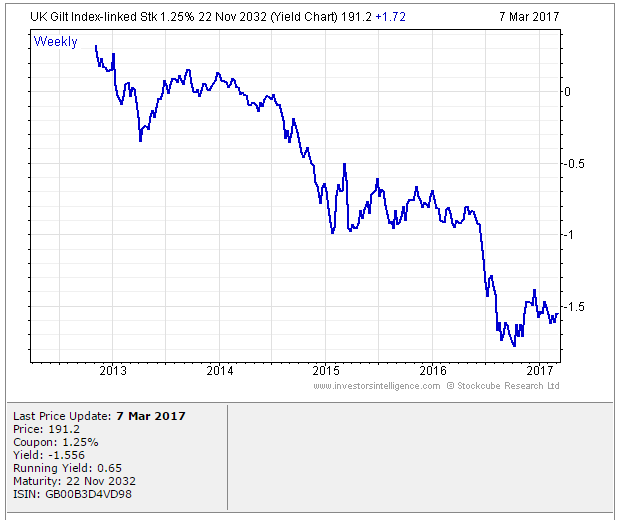 So what does this have to do with Ogden Rates? So now we are in a position to link this back to the recent change in the Ogden Rate. Because the yield on index-linked bonds has traditionally been used as a proxy for a risk-free real return, the yield is still used to decide the discount rate that should be used to calculate court award payouts. Because Pension Schemes have been driving up the price of these bonds so much, we have the bizarre situation that the amount that insurance companies have to pay out to claimants has suddenly jumped up considerably. In the case of a 20 year old female for example, the amount that would be paid out has almost tripled. As these pay outs are already considerable, the financial impact of this change has been massive. So what should the Government do? There is no easy answer, if the Government doesn't use the yield on index-linked gilts to calculate the Ogden rate then there is no obvious alternative. I think the most reasonable alternative would be to use a weighted average of returns on the types of assets that an average claimant would hold. For example, we might assume the claimant is going to hold 50% of their lump sum in cash, 30% in shares, and 20% in bonds, and we would then calculate the weighted return from this portfolio. The issues with doing nothing is that the additional cost from these increased pay outs will inevitably be passed on to the policyholders through higher premiums. So ultimately there is an issue of fairness whereby people who are receiving payouts are being paid a disproportionate amount of money, and this is being subsidised by policyholders other policyholders. Which areas of actuarial work are the best paid? Salary estimates for actuarial work are pretty hard to come by and in my experience not particularly accurate, Also, in practice there are also large differences in salary when accounting for experience, practice area, function, and location. So I thought I'd try to put together my own analysis which accounts for all these variables! As a source of data I decided to work from online Job Adverts, mainly because I can collect them with a minimum of effort, but also because the only other option would be to send out my own survey (and to be honest why would anyone complete a salary survey from a random guy online?). Step 1. Collect Some Data I started by web scraping about 800 job adverts from an actuarial job site. This was all the job which were listed on the website at the time. Since this might be 'slightly' (i.e. completely) against the terms of service of the site, I won't say which site the adverts are from or publish any of the raw data. I don't see any issues with publishing aggregated data from the website though. Once I had scraped the adverts, I extracted the salary figures and discarded adverts that did not include a salary, this left about 350 job advert to work with. Step 2. Analysis My first step was to segment the adverts by practice area. Rather than going through each advert one at a time, I split them by looking at key words in the adverts, for example, adverts containing the terms 'pensions', 'employee benefits', or 'defined contribution' were all assigned to the category 'Pensions'. These figures were then used to produce the following box and whiskers chart: 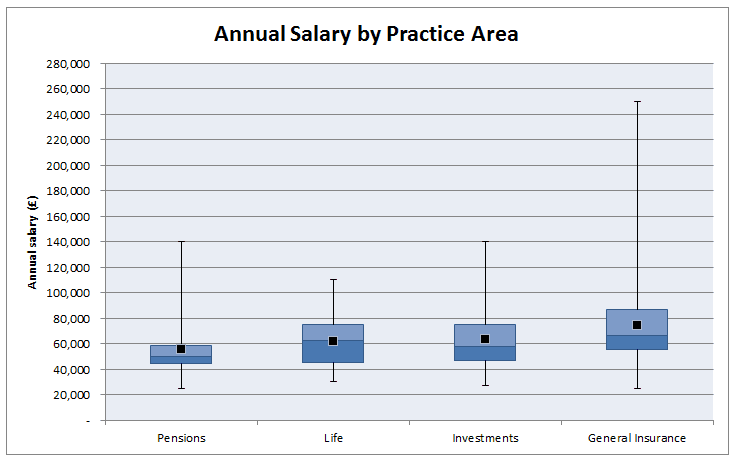 As expected, General Insurance comes out as the highest paid practice area with Life and Investments in joint second place and Pensions lagging quite a bit behind. In case you can't remember how a box and whiskers chart works, the black dot is the mean, the three lines in the box represent the 1st quartile, median, and 3rd quartile, and the whiskers go up to the maximum and down to the minimum value. Are there any other correlations that are affecting this ranking though? Since a lot of GI jobs are based in London, does London's higher average salary accounts for the difference? First let's check that actuarial jobs in London do actually have higher salaries than actuarial jobs outside London. 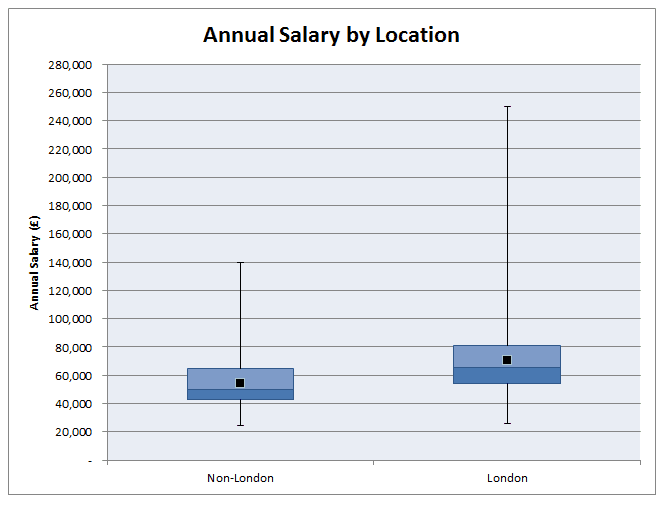 As expected, London based jobs are clearly better paid on average than non-London based jobs. In order to see whether location is driving the differences between salaries across practice areas we need to include location as another variable in our chart: 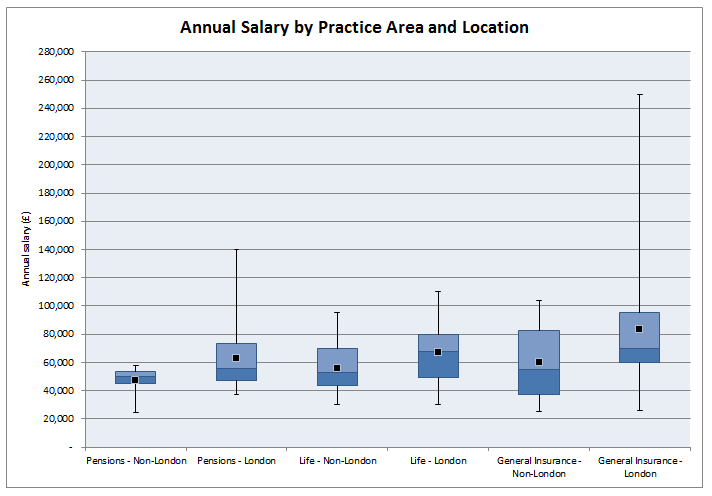 This chart gets a bit more messy, but we can see that even when we account for the effect of location, we still have the same ordering of practice area: General Insurance > Life > Pensions Now that we've looked at practice areas, I'm going to show my bias towards insurance and look at the effect of the type of actuarial work within an insurance company on salary. 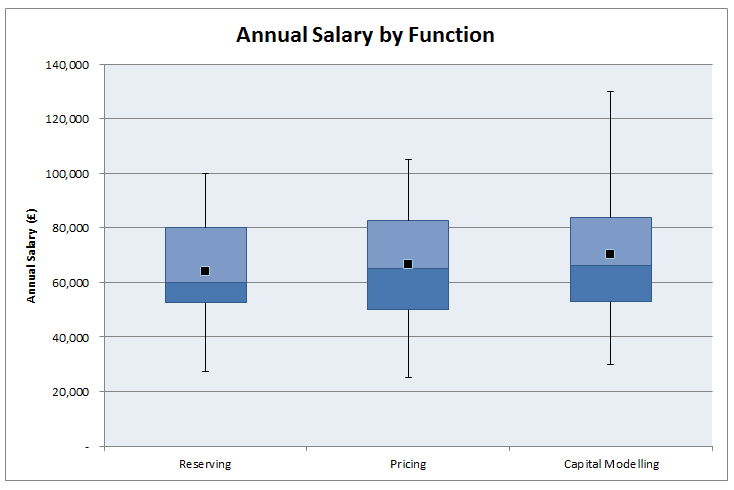 Surprisingly, all the functions are relatively equal. There seems to be a weak ordering of: Capital Modelling > Pricing > Reserving Though the difference does not seem to be significant. 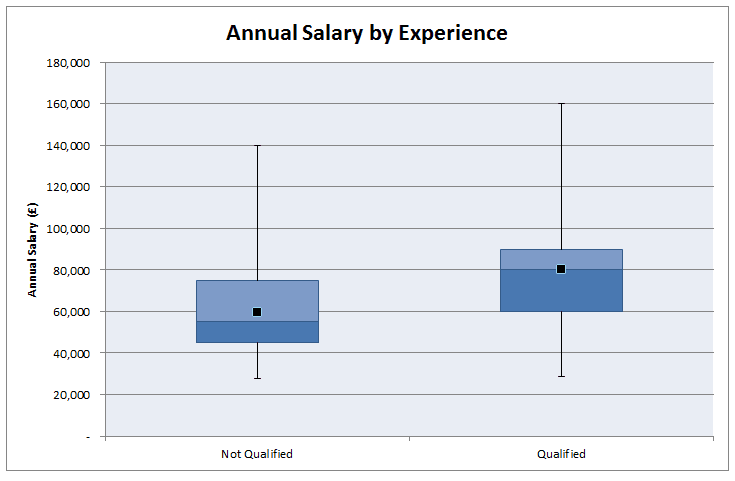 Finally, let's look at the effect of qualifying on salary. As expected, jobs for qualified actuaries have a mean of £20,000 higher than part/nearly qualified positions. All the more reason I should be studying right now rather than procrastinating on here!. I offer tutoring for IFoA exams and actuarial modules. Details here www.lewiswalsh.net/tutoring.html
Background Lloyd’s or Lloyd's of London is an insurance marketplace located in the City of London. It developed out of an informal meeting of ship owners, merchants and sailors in Edward Lloyd's coffeehouse. The original coffeehouse first opened in 1688 making Lloyd's over 300 years old. Lloyd's really is a unique and interesting institutional, and there is really nothing else quite like it. For example, did you know that Lloyd's uses an accounting system that runs for thee years rather than the usual one year accounts that most companies use? Three years was the length of time that a 17th century ship took to circumnavigate the globe, and since most of the business written at Lloyd's during it's early years was Marine insurance, it was decided that it was a good idea to run the accounts for three years and it hasn't changed since. But how does Lloyd's work in practice? Who pays whom for what and how do they decide how much to pay? And how do people make money from all of this? 
Syndicates Syndicates are the basic building blocks of Lloyd's. The word syndicate just means a group of people and in the context of Lloyd's, a Syndicate is a group who are willing to collectively write insurance. Is there a name for the people who make up the Syndicate? Yes there is! They are called Members. The Members join together to form a Syndicate. Members come in many different forms, some will be individual investors, who might have a relatively modest net worth, others will be specialist insurance companies, set up specifically to write business at Lloyd's and worth billions of dollars. The word Member applies equally to both. Members which are set up as companies are called 'Corporate' members, and contribute the majority of the capital at Lloyd's. Individual investors in Lloyd's are called 'Individual Members', or 'Names'. Historically Names made up a majority of the capital, but they are less important now. Even though the Syndicate is the one who provides the insurance to the policyholder, they will not sell the insurance directly to the policyholder, instead a Syndicate will employ a Managing Agent (not to be confused with a Managing General Agent - MGA - which is a separate type of entity) to underwrite the insurance on its behalf. Some Managing Agents will deal with multiple Syndicates and some will deal with just one Syndicate. The Managing Agent will most often arrange the insurance through insurance brokers. That's quite a few different groups, so here's an image showing how they all fit together. 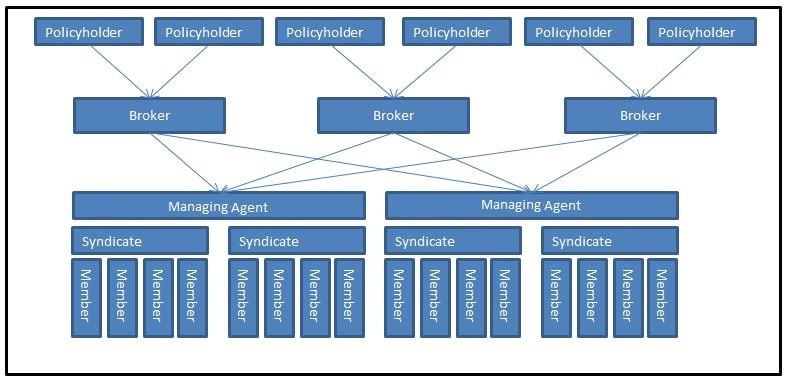
How do Members make money at Lloyd's?
Members agree to write business at Lloyd's for one year at a time. A given year of account will then be kept open for three years. (Remember earlier when we mentioned that this was the length of time it took a 17th century ship to circumnavigate the globe, that's where this number comes from) At the end of the three years, the syndicate will settle up all the outstanding business through a process called Reinsurance to Close (RITC), and then all the profits or losses from all the from all the contracts the Syndicate has written in that year are shared among the members in proportion to the amount of capital they provided to the Syndicate. For example, suppose that in a given year Syndicate A made a profit of £10m and suppose that Member Z provided 2% of the capital that the Syndicate required that year. Then Member Z would receive a payment of £10m * 2% = £200,000. On the other hand, suppose that Syndicate A actually lost £10m over the year, then Member Z would be liable to cover their share of the loss, in this case, £200,000. Therefore all the Members of a Syndicate share in the fortunes of the Syndicate. Here is a graphic with a very simplified example showing a timeline of how this would work in practice. 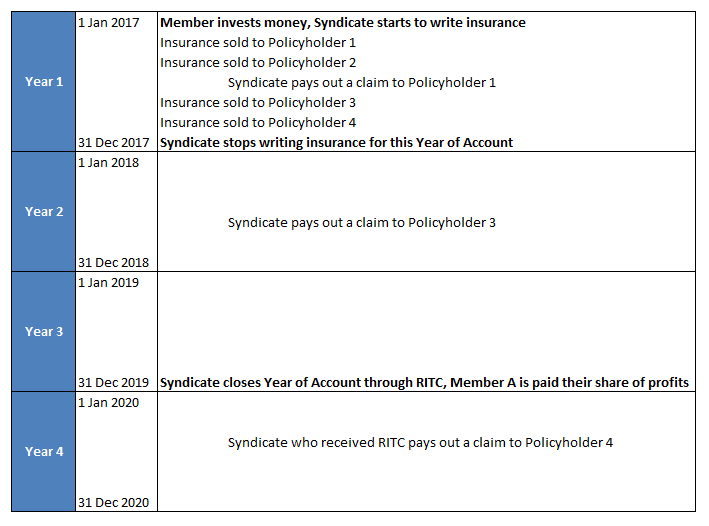
How do Syndicates get business?
Business at Lloyd's is placed through insurance or reinsurance brokers. A policyholder will approach a broker and ask them to arrange an insurance contract at Lloyd's. The broker will then typically place the contract at Lloyd's through the 'slip system'. Slip System The broker will produce a 'slip' which contains all the details of the risk which is to be insured. For example, a slip might be a contract to insure a large industrial plant from fire damage. Syndicates (through their Managing Agent) may then decide to underwrite a percentage of the slip. What this means in practice is the syndicate will take a percentage of the premium, and then if there is a loss, they will be liable for a percentage of the insurance claim. For example a syndicate might take 5% of the risk. This means that they will receive 5% of the premium that the policyholder pays and be responsible for 5% of the claims arising from the contract if there is fire damage to the industrial plant. The process of spreading the risk around different syndicates is known as coinsurance. As an aside, this is where the term 'Underwriter' originally comes from. When an insurer writes a share of a risk (also known as 'taking a line on the risk'), they will sign their name at the bottom of the slip, along with the % share they are willing to write. Hence the term 'underwriter' - people who write their name under the text of the document. Isn't this unneccssarily complicated though? What's the point of everyone take a share? Why can't one syndicate just take on 100% of the risk? The answer is they can, and sometimes do, particularly for smaller risks. However it will probably be very hard to find a syndicate that is willing to take 100% of a very large risk. Going back to our industrial plant example, if the plant is worth hundreds of millions, the claim size could potentially be in the hundreds of millions too. Let's pause to think about what's going on here then. We saw in the previous section that all the members in a syndicate share the profits and losses from all the contracts that the Syndicate writes in the year, but we now have another type of sharing in the form of coinsurance. So for a given contract we might have a dozen syndicates all sharing the risk, and inside each syndicate we might have dozens of members also sharing the risk of their syndicate. Therefore each contract could potentially be shared by hundreds of members! The following graphic shows how the slip system works. 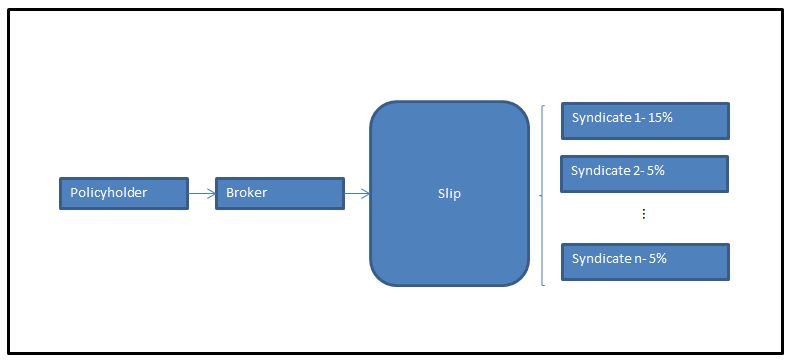

Capital Requirements Any time an insurance contract is written, capital is required to cover the possibility that the claims might be larger than the premiums. Otherwise there is a risk that a policyholder might not be able to claim from the insurer if the insurer gets into financial trouble. Given the complicated way that business is written at Lloyd's, how do we decide how much capital to take from each member, and how is this capital held? The policyholder will pay a premium to the insurer in exchange for the insurer taking on the risk. We saw earlier that this premium will be spread among multiple syndicates depending on which ones sign the slip. Each syndicate will hold the premium it receives from policyholders in a Premium Trust Fund (PTF). The PTF will be a pool of all the premiums that the insurer receives throughout the year, rather than the Syndicate keeping separate funds for each policy written. What happens though if the claims are larger than the premiums across all the business written for the year? The syndicate will run out of money in their PTF and will need additional capital. To cover this possibility members will deposit 'Funds at Lloyd's' (FAL) with their Syndicate. For a given syndicate, if their PTF proves to be inadequate to cover claims, then the syndicate will have made a loss and the FALs will be used to make up the difference. What happens in the unlikely event that even the FALs are too small to cover the claims? To cover this eventuality, all members are also required to contribute a small amount every year to the Lloyd's central fund. This fund is only used to pay claims if the FALs for a given syndicate prove inadequate. The following graphic illustrates this process. 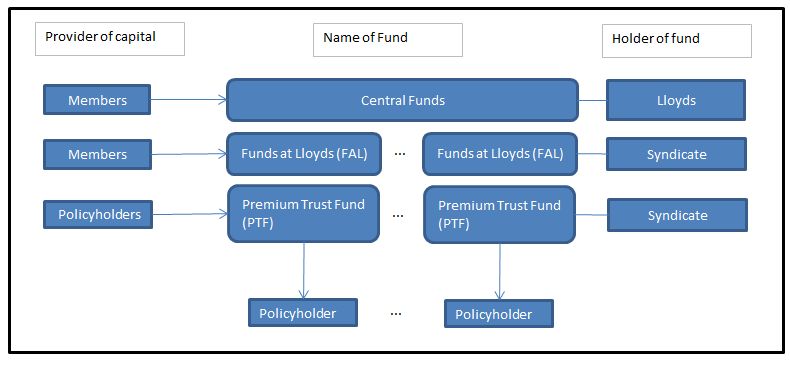
If you enjoyed this article, but would like to find out more, I have also written a FAQs about Lloyd's which can be accessed through the link below:
www.lewiswalsh.net/blog/faqs-about-lloyds-of-london
I offer tutoring for IFoA exams and actuarial modules. Details here www.lewiswalsh.net/tutoring.html
Why do we use the Poisson Distribution as the default distribution for modelling Claims Frequency for an insurance portfolio?
Why do we even have a default? When we are setting up a frequency-severity model to model claims from a insurance portfolio, we will normally approach the fitting of a frequency distribution and the fitting of the severity distribution quite differently. For the frequency distribution the standard approach is to attempt to fit a Poisson distribution, and only look at other distributions if the Poisson is not a good fit (even then we normally limit our search to Negative Binomial, and maybe Binomial at a stretch) When we fit a severity model however, we will often fit quite a large range of different continuous probability distribution to the empirical Claim Severity CDF using some sort of curve fitting software and then select the most appropriate curve. Some Distributions are used more often than others, for example, LogNormal, Pareto, Weibull are all common curves to use, but there is no single curve that we would assume the severity distribution conforms to by default. So why is a Poisson distribution a natural distribution to use to model claims frequency? And why is there no 'natural' distribution for claim severity? In this post I thought I would write up an interesting result that shows that a counting distribution which has a number of basic properties will be distributed with a Poisson distribution. We will then be able to see that are reasonable assumptions to make about Claims Frequency for an insurance portfolio.
Poisson Distribution
Before working through this result, here are a list of additional properties the Poisson Distribution has which make it easy to work with:
$$ N \sim Poi( \lambda )$$
Then
The Result
Let $A(t)$ for ($t >0$) denote the the number of claims in the interval $[0,t]$. With $A(0) = 0$.
Suppose:
$$P( A(t + \delta t) - A(t) \geq 2 ) = o( \delta t)$$
The Proof
Define $P_n (t) = P( A(t) = n ) $
We then examine the change in $P_n(t)$ over a time period $\delta t$ and then take the limit as $\delta t$ approaches $0$.
for $n > 0$: $$P_n(t + \delta t) = P_n(t)(1 − \lambda \delta t) + P_{n−1} (t) \lambda \delta t + o( \delta t) $$ for $n = 0$: $$P_0(t + \delta t) = P_0(t)(1 − \lambda \delta t) + o( \delta t)$$
This follows from the facts that there are two distinct ways for $n$ claims to happen in a time period $t + \delta t$. Either we get $n$ claims in time $t$ and no claims in $\delta t$, or $n-1$ claims in time $t$ and one claim in $\delta t$.
We can rewrite these equations as: for $n > 0$: $$\frac { Pn(t + δt) − Pn(t)}{\delta t} = \frac {−P_n(t)( \lambda \delta t) + P_{n−1}(t) \lambda \delta t + o(\delta t)} { \delta t}$$ for $n = 0$: $$\frac {P_0 ( t + \delta t) − P_0(t)} {\delta t} = \frac {P_0(t)(− \lambda \delta t) + o(\delta t) } {\delta t}$$ Now take the limit as $\delta \to 0$ which gives: for $n>0$: $$\frac { d P_n (t)} {dt} = − \lambda P_n(t) + \lambda P_{n−1}(t)$$ for $n=0$: $$\frac {d P_0 (t)} {dt} = - \lambda P_0 (t)$$ From inspection we can see that $P_0 (t) = e^{ {- \lambda} }$ The proof for the general case can easily be shown with induction. We therefore see that $P_n$ has a Poisson distribution.
Poisson as the natural distribution
So we see that, in so far as insurance claims occur in line with the assumptions (independently over the time interval, and only one at a time) we can expect the claims frequency to have a Poisson Distribution. In addition, the Poisson Distribution has a number of properties which make it easy to work with - having a single parameter, having simple formulas for the mean and variance, etc. Therefore, whenever we are fitting a claim frequency model, we will almost always try the Poisson Distribution first. Captive Insurance31/1/2016 Here is an Acronym I came up with for remembering the reasons for setting up a captive Insurance company:
Claims control Access to Reinsurance Profit loading and Acquisition costs Tax and Regulatory optimization Investment income Volatility in premium rates Extension of coverage Claims control - As the captive is directly controlled by the parent company, the parent company is free to establish the claims handling procedures. For example, they may wish the captive to operate a very liberal interpretation of what is covered under the policy, thereby reducing the possibility that the parent company will be exposed to a financial loss which they thought they were indemnified from. If the parent company were dealing with a commercial insurer instead then they would be at the mercy of the exact policy wording. Access to Reinsurance - By self insuring, the parent company gives itself the option of then ceding the risk directly to a reinsurer rather than going through an insurance company. Reinsurers tend to enjoy greater economies of scale than direct writers, and incur lower acquisition and claims handling costs due to the smaller number of clients they deal with. Therefore the premiums charged by a reinsurer would be lower than that charged by a direct writer. Profit loading and acquisition costs – Due to the fact that most insurers are run as limited liability companies, the premiums that are charged by the insurer will be loaded for profit. There will also be significant loadings for expenses and acquisition costs (the costs associated with acquiring new business). By setting up a captive the parent company can eliminate these loadings and instead just pay a pure risk premium. These loadings can be significant, sometimes as high as 50%. Investment Income – The captive will be required to hold capital to cover the liabilities that it is taking on by accepting the risk from the parent company. This capital can be invested and the investment income retained in the captive. This investment income would otherwise be earned by the insurance company. (Admittedly the insurance company would be expected to reflect this fact in the premium that it charges however this may not always be the case) Volatility in premiums rates - If the parent company uses a commercial insurer rather than a captive then the premium charged by the insurance company will be partly market driven. Premium rates vary over time in line with the underwriting cycle beyond how they would be expected to vary based on the pure risk premium. The underwriting cycle is related to the cost of capital and the level of profit and competition between insurance companies. This can add an additional level of volatility to the premiums paid by the parent company. By setting up a captive the parent company can help stabilize the premiums that it pays. Extend coverage – Insurers may be unwilling to accept certain risks which they deem to large or too unique, or they may charge premiums that are excessively cautious when taking on these risks. The ability to dictate to a captive the risks that it should accept extends the coverage available to the parent company. This is one of the primary reasons for setting up a captive. |
AuthorI work as an actuary and underwriter at a global reinsurer in London. Categories
All
Archives
October 2026
|
 RSS Feed